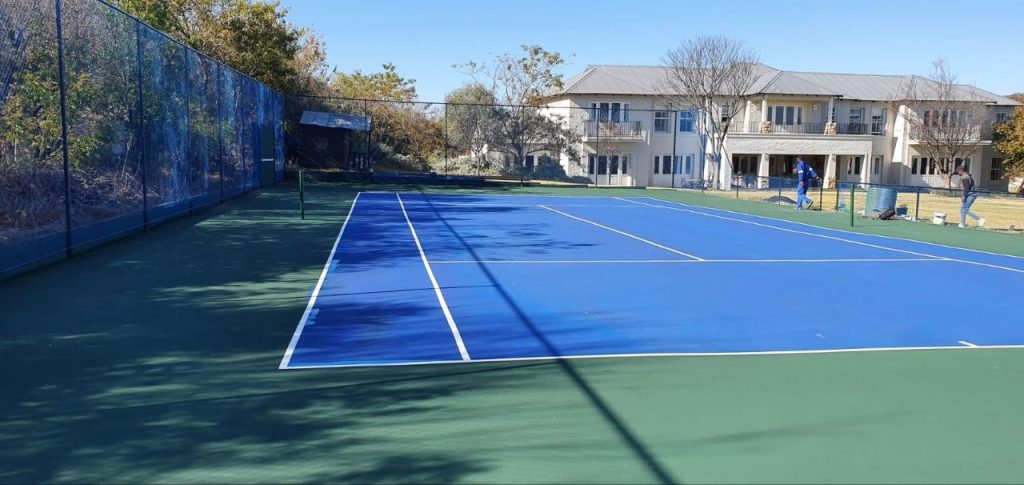
Most courts do not fail suddenly. They fade, they crack at the edges, and the bounce goes uneven long before anyone calls it a problem. Catching that early is the difference between a resurface and a rebuild.
This guide covers what tennis court resurfacing costs in South Africa, when it is the right call, and when your court has gone too far for a re-coat to help.
Tennis court resurfacing cost in South Africa
Published South African figures for 2026 put periodic resurfacing at roughly R45,000 to R75,000 for a standard court, carried out every five to seven years.
Sports court surfacing quoted per square metre generally runs about R105 to R145. On a 200 square metre area that works out to roughly R21,000 to R29,000, though a full tennis court including run-off is considerably larger than that.
For comparison, building a new court from scratch averages around R225,000, and synthetic grass courts run far higher again.
That gap is the whole argument for resurfacing on time. A re-coat at year six costs a fraction of a rebuild at year fifteen.
Signs your court needs resurfacing
Look for these, roughly in order of urgency:
- Faded colour and worn line markings. Cosmetic at first, but it means the acrylic layer is thinning.
- Surface cracking. Fine hairline cracks are normal wear. Wide or branching cracks are not.
- Ponding. Water still sitting on the court an hour after rain points to settlement or a drainage problem.
- Inconsistent bounce. The ball behaving differently in different areas means the surface has broken down unevenly.
- Loose or flaking acrylic. Once the coating lifts, water gets underneath and the damage accelerates.
A court showing the first two is a straightforward resurface. A court with ponding and structural cracking needs assessment before anyone quotes a colour coat.
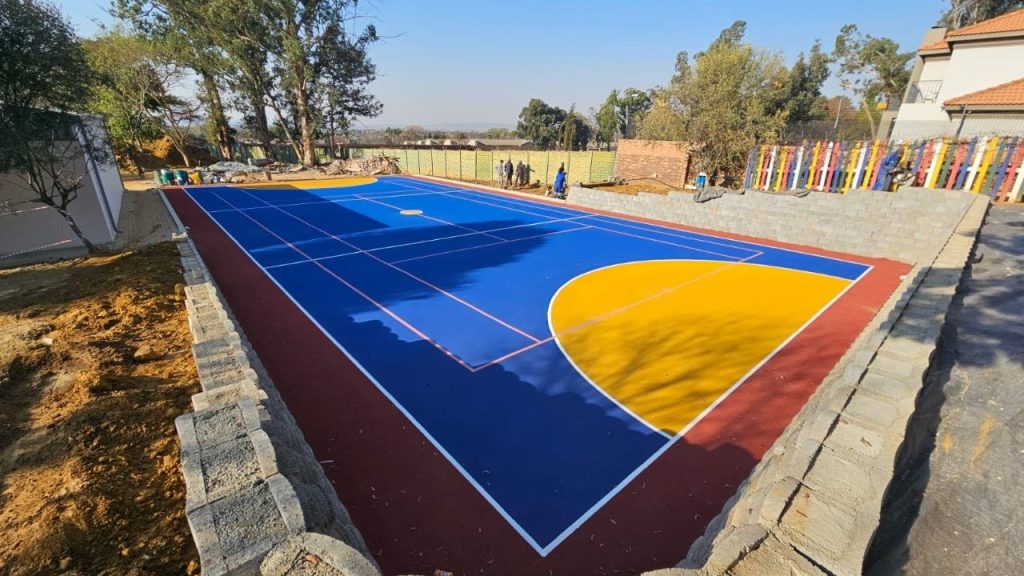
Resurfacing or rebuilding
Resurfacing works when the base is sound. The process cleans the existing surface, repairs cracks, applies new acrylic layers and re-marks the lines. The foundation stays where it is.
A rebuild is necessary when the base itself has failed. Signs of that include large settlement areas, cracks that reappear within months of repair, and drainage that has never worked properly.
Putting new acrylic over a failed base is money thrown away. The cracks come straight back through the new surface, usually within a season.
An honest contractor will tell you which one you need after looking at the court, not over the phone.
What the work involves
A typical resurface runs through cleaning and pressure washing, crack repair and patching, levelling any low spots that hold water, applying acrylic resurfacer and colour coats, then setting out and painting the lines by hand.
Weather governs the schedule. Acrylic needs dry conditions and reasonable temperatures to cure properly, so Cape Town winters are difficult and most court work happens in the warmer, drier months.
Plan the job for a school holiday or an off season if the court is in regular use.
Getting the most from a new surface
Keep the court clean. Leaves and organic debris hold moisture against the acrylic and encourage growth that degrades it.
Deal with cracks early while they are cheap patches rather than late when they are structural repairs. Keep the drainage clear so water leaves the court instead of sitting on it.
Done properly, that routine gets you the full five to seven years and often more.
We build, resurface and repair tennis, netball and multi-sport courts for schools, estates, churches and private clients around Cape Town. See our tennis court construction and resurfacing services, browse the gallery, or request a free site assessment.
Building rather than repairing? Our guide to what goes into building a tennis court covers the process from base to line marking.
Budgeting tennis court resurfacing across several courts
Schools, clubs and estates rarely have one court, and doing four at once is a large single cost. Phasing is usually the answer.
Assess all the courts together, rank them by condition, and resurface the worst first. Courts still in reasonable order can often wait a season or two if they are cleaned and their cracks patched in the meantime. That converts one large capital item into a manageable rolling programme.
It also spreads disruption, which matters when courts are timetabled for lessons or league fixtures. We plan this kind of work around term dates and quiet periods, and you can see the approach on our court services page.
What a proper assessment covers
A quote given over the phone is a guess. A real assessment looks at the crack pattern and whether it is surface or structural, how water behaves on the court after rain, the condition of the perimeter and fencing, and the state of net posts and fixings.
That last point catches people out. Posts set in failing concrete will need attention regardless of how good the new surface is, and it is far cheaper to deal with them while the court is already out of use.
We assess courts free of charge across Cape Town and the Helderberg, including Somerset West and surrounding estates. See completed courts in the gallery.
Frequently asked questions
How much does tennis court resurfacing cost in South Africa?
Published 2026 figures put a standard court resurface at roughly R45,000 to R75,000. Sports court surfacing quoted per square metre generally runs R105 to R145. Court size, condition and the extent of crack repair drive the final number.
How often should a tennis court be resurfaced?
Every five to seven years for a court in regular use. Courts that are cleaned and kept free of standing water often stretch beyond that.
Can you resurface a badly cracked court?
It depends on why it cracked. Surface cracking over a sound base can be repaired and re-coated. Cracking caused by base failure or settlement will come back through the new surface, so the base has to be fixed first.
How long does resurfacing take?
Most courts take several days to about a week depending on size, the amount of repair needed and the weather. Acrylic needs dry conditions to cure, so rain extends the schedule.
Is resurfacing cheaper than a new court?
Considerably. A resurface at R45,000 to R75,000 compares with roughly R225,000 to build a new court. Resurfacing on schedule is what keeps a court out of rebuild territory.