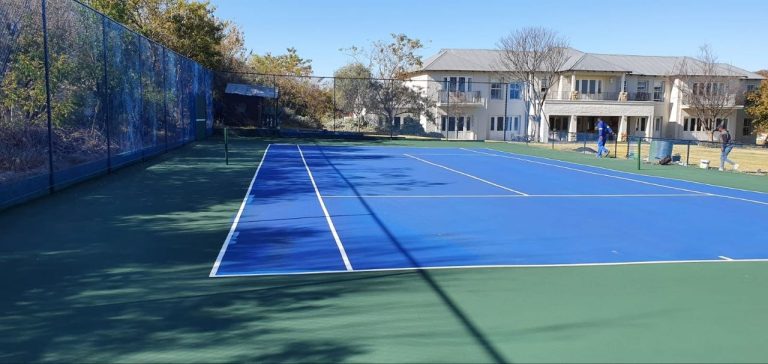
A tennis court is a civil engineering job with a paint finish on top. Almost everything that determines whether it plays well and lasts twenty years happens below the colour you actually see.
Here is what tennis court construction involves from first site visit to first serve.
Site survey and setting out
The first job is deciding exactly where the court goes and which way it faces.
Orientation matters more than people expect. A north-south alignment keeps the low morning and evening sun out of players’ eyes. Getting this wrong makes a technically perfect court unpleasant to use at the times people most want to play.
The survey also establishes levels, existing drainage and access for plant. A full-size court plus run-off needs a bigger footprint than the playing lines suggest, so this is where a site either works or does not.
Earthworks and the base
The base is the court. Everything else is a finish.
Topsoil is stripped and the area excavated to depth. Layers of crushed stone are placed and compacted in stages, each one tested before the next goes on. Falls are built in so water runs off the surface rather than sitting on it.
Skimping here is the single most expensive mistake in court building. A base that settles produces cracks that will reappear through every resurface for the life of the court.
Surfacing
Once the base is right, the asphalt or concrete layer goes down and is left to cure. Acrylic will not bond properly to a surface that has not fully cured, so this stage cannot be rushed.
Then come the acrylic layers: a resurfacer to even out texture, followed by colour coats. These build the playing characteristics. More sand in the mix gives a slower, higher-friction court; less gives a faster surface.
Sports court surfacing in South Africa is generally quoted at around R105 to R145 per square metre, and a full new court averages roughly R225,000.
Fencing, nets and lighting
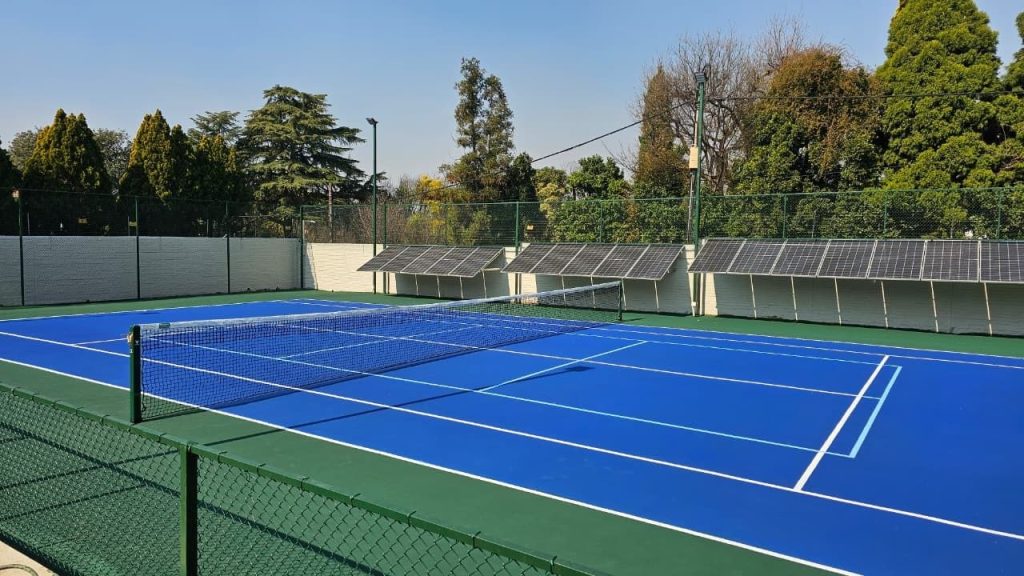
Fencing keeps balls in and defines the court. Height and mesh specification depend on how the court is used, with school and club courts usually needing more than a private garden court.
Net posts are set in concrete foundations at the correct spacing and height. Getting the post positions wrong is difficult and expensive to fix later.
Floodlighting, if you want evening play, is far cheaper to install during construction than to retrofit, because the cable routes can be laid before surfacing.
Line marking
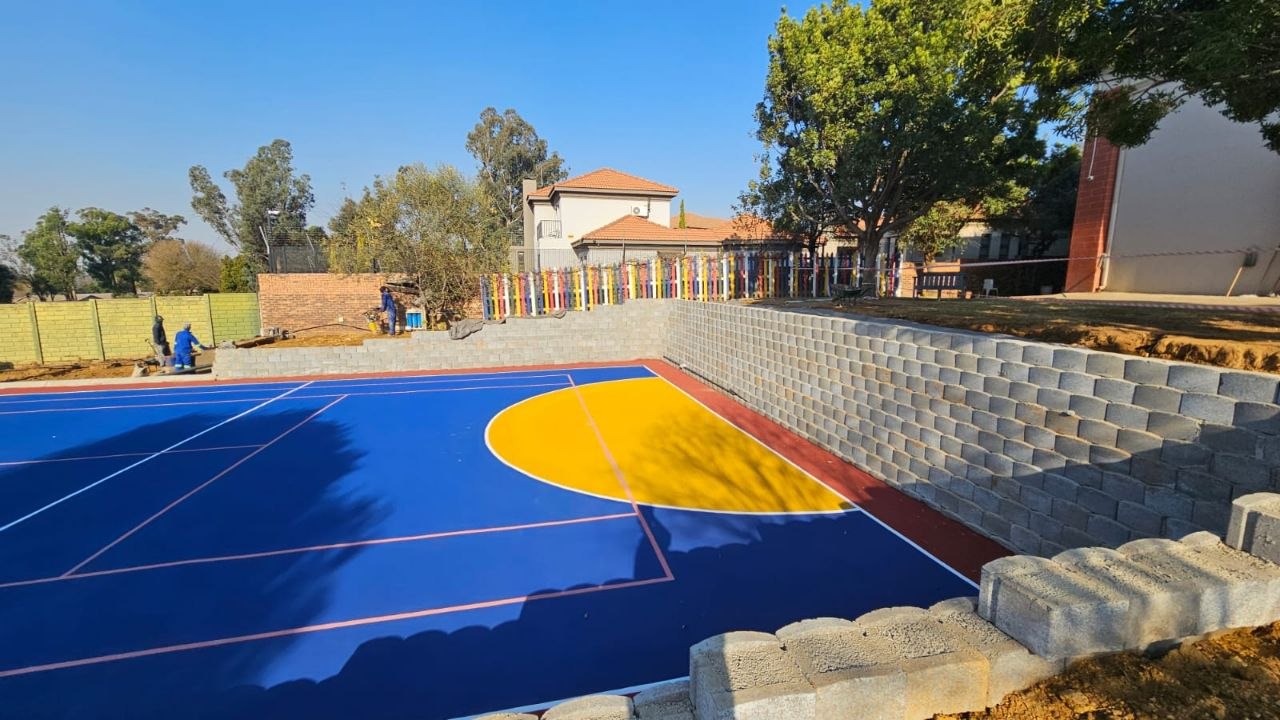
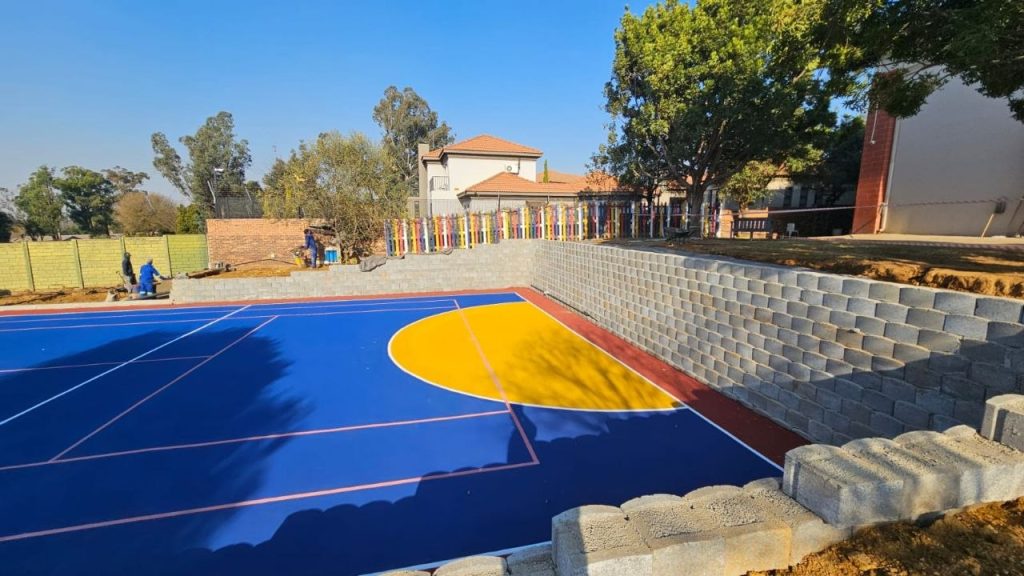
Lines are set out by hand to the correct dimensions, masked and painted. On a multi-purpose court, tennis, netball and basketball layouts are marked in different colours on the same surface.
This is precision work. A court measured carelessly is visibly wrong to anyone who plays regularly, and there is no easy fix once the paint is down.
Timeline and planning
Allow several weeks for a new court, longer if the site needs significant earthworks. The base has to be compacted and tested in stages, and the asphalt has to cure before surfacing.
Weather governs the acrylic stages. Dry conditions and moderate temperatures are needed, which makes the warmer months the practical building season in the Cape.
Multi-purpose courts are worth considering if space is limited. One well-built surface can carry tennis, netball and basketball markings and serve a school or estate far better than a single-use court.
We build, resurface and rehabilitate tennis, netball and multi-sport courts for schools, estates, churches and private clients. See the full court construction service, view completed courts in the gallery, or arrange a site visit.
If you have an existing court, our guide to resurfacing costs and warning signs will tell you whether it needs a re-coat or a rebuild.
What tennis court construction costs cover
The headline figure for a new court hides a wide spread, because the base is priced on ground conditions and those vary enormously from site to site.
A flat, well-drained site with good access is the cheap case. A sloping site needing cut and fill, retaining, or a long haul for plant and material is the expensive one. Two identical courts a kilometre apart can differ substantially for this reason alone, which is why we survey before quoting rather than after.
Fencing, floodlighting and nets are usually priced separately. Decide early whether you want them, because installing lighting after surfacing means digging up work you have already paid for. Costs for the alternative route are in our resurfacing guide.
Choosing a surface specification
Acrylic hard courts are the common choice in South Africa. They are durable, they suit the climate, and the playing speed can be tuned by adjusting the sand content in the coating.
Faster surfaces suit club and social play. Slower, higher-friction surfaces give longer rallies and are often preferred for coaching and junior development, so it is worth asking who will actually use the court before settling the specification.
Multi-purpose marking is worth deciding at this stage too. Adding netball or basketball lines during construction costs very little; adding them later means masking and re-coating. We build courts for schools and estates across the region, including Somerset West and the Helderberg, and you can view finished work in the gallery.
Frequently asked questions
How much does it cost to build a tennis court in South Africa?
A standard court averages around R225,000, with surfacing quoted at roughly R105 to R145 per square metre. Synthetic grass courts cost substantially more. Site conditions and earthworks are the biggest variables.
How long does it take to build a tennis court?
Several weeks in most cases. The base must be built and compacted in tested layers, the asphalt has to cure, and the acrylic coats need dry weather, so the schedule depends heavily on conditions.
Which direction should a tennis court face?
North to south is the standard recommendation. It keeps the low morning and evening sun out of players’ eyes, which matters most at the times courts get used.
Can one court be used for tennis and netball?
Yes. Multi-purpose courts carry tennis, netball and basketball markings in different colours on a single surface, which is a practical choice for schools and estates with limited space.
What is the most important part of a tennis court?
The base. Surface colour and line marking are visible, but a properly excavated, layered and compacted base with correct falls determines whether the court cracks, drains and lasts.